Swim · Bike · Run

Triathlon training plan for beginners

Three sports, one finish line, zero mystery. Build a week-by-week plan for your first race, learn the transitions, and predict your finish time — written for people starting from scratch.

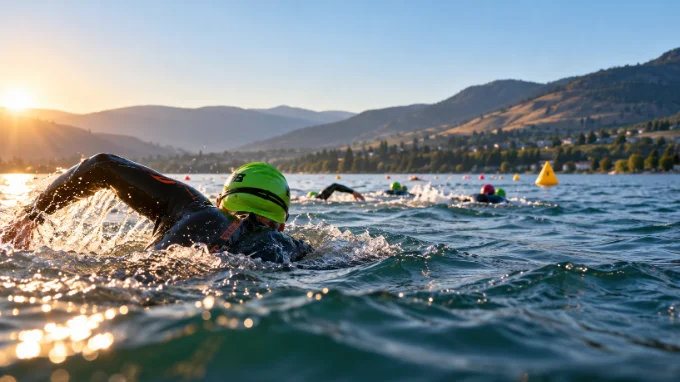
Open-water swimmer training at sunrise
01Start Here
3sports in one race: swim, bike, run
8–12weeks is a realistic first-timer build
~6 hrsa week at the peak of a sprint plan
2+2+2typical weekly sessions per discipline
Start here

Yes, you can do a triathlon

A triathlon strings three sports together in one continuous race: you swim, then ride a bike, then run, with two changeover areas called transitions in between. It sounds daunting because it is three sports instead of one, but that is also the secret to why beginners succeed. The variety spreads the load across different muscles, the training rarely gets boring, and no single discipline has to be fast — you simply have to keep moving and manage the switches between them.

The honest prerequisite for a first sprint-distance race is modest. If you can swim a continuous 100 to 200 metres, ride a bike for roughly 45 minutes, and run or run-walk for 15 to 20 minutes without stopping, you have a base to build from. If you are not quite there yet, that is fine: the first few weeks of any beginner plan exist to get you to that baseline safely. The goal of a first triathlon is not to win; it is to cross the line smiling and to want to do another.

This guide is built around two tools. The plan builder turns your race distance, your timeline and your experience into a sensible weekly structure, and the finish-time predictor turns your training paces into a realistic race-day estimate. Around them you will find the distances explained, how a training week actually fits together, how to handle transitions, what gear you truly need, and where to race once the Okanagan season opens. One note before anything else: training stresses the heart, lungs and joints, so if you are new to exercise or have any health concern, talk to your physician before you start.

Choose your race

Triathlon distances explained

Pick the distance that matches your timeline and current fitness. Almost everyone should start at sprint — it is long enough to feel like a real achievement and short enough to train for around a normal life.

DistanceSwimBikeRunWho it suits
Super-sprint300–400 m8–10 km2–2.5 kmA first-ever taster; very time-crunched beginners.
Sprint750 m20 km5 kmThe classic first triathlon. Start here.
Olympic1.5 km40 km10 kmYour second season, once sprint feels comfortable.
70.3 (half)1.9 km90 km21.1 kmAn endurance goal needing months of consistent base.
Leg 1

The swim

Usually the shortest leg in time but the one that worries beginners most. Practise in open water if you can, learn to sight off landmarks, and treat the first few hundred metres as a controlled warm-up, not a sprint.

Leg 2

The bike

The longest leg and where most of your time is spent. Any road or hybrid bike in good working order will get you to your first finish — fitness and a safety check matter far more than an expensive machine.

Leg 3

The run

Short on paper, hard in the legs. After cycling your legs feel heavy and strange for the first kilometre, which is exactly why brick workouts — a run straight off the bike — are worth practising.

Interactive · build your week

Beginner training plan builder

Choose a distance, how long you have, and your experience. You will get a sensible weekly shape — not a rigid day-by-day script, but the structure good beginner plans share.

1 · Race distance
2 · Weeks until race day
3 · Your experience
How the week fits

What a training week actually looks like

Nearly every beginner plan is built from the same simple blocks: about two sessions in each sport per week, one slightly longer session on the weekend, at least one full rest day, and a gradual rise in total time from around three hours a week to five or six at the peak. That is roughly six workouts a week, most of them short. You do not need marathon-length sessions; you need consistency, and a week you can actually repeat.

Spread the hard and easy days so you are never stacking two demanding sessions back to back. A sample sprint week might pair an easy swim with a steady ride early in the week, slot a short run and a technique swim midweek, keep one true rest day, and save the longer ride plus a short run off the bike for the weekend. As race day approaches you add one or two brick workouts — a bike immediately followed by a run — and, a couple of weeks out, a full swim-bike-run rehearsal at an easy effort so nothing on race morning is a surprise.

The last week before your race is a taper: cut the volume roughly in half, keep a little intensity so you feel sharp, sleep well, and resist the urge to cram fitness you have not already built. Trust the weeks behind you.

Underneath all of this sits the least glamorous and most important principle: recovery is where you get fitter. Training is only the stimulus; your body adapts during the rest between sessions, not during the sessions themselves. That is why the rest day is non-negotiable and why stacking hard days leads to flatness, not progress. Protect sleep as if it were a workout, keep easy days genuinely easy, and treat niggles early — a few days off at the first sign of a sore Achilles or knee is far cheaper than the weeks a real injury will cost you. Most beginner setbacks come not from doing too little but from doing too much, too soon, with too little rest. Build the habit of consistency across months rather than heroics across a weekend, and the fitness arrives on its own.

Cyclist training on an open road
Three sports, three skills

How to train the swim, the bike and the run

You do not have to be good at all three — you have to be competent and comfortable. Here is where beginners should spend their attention in each discipline.

The swim: calm beats fast

For most beginners the swim is the scariest leg and the one that improves fastest with a little technique. Spend your early sessions learning to breathe on a relaxed rhythm and to swim in a straight line rather than chasing speed. In the pool, break the distance into manageable repeats — several lengths with short rests — and slowly stitch them together until a continuous 750 metres feels ordinary. If your race is in open water, get into a lake at least a few times before race day: open water has no black line to follow, no wall to push off, and a wetsuit changes how you float and breathe. Practise sighting by lifting your eyes just enough to spot a landmark every few strokes so you swim the shortest line. On race morning, start at the back or side of your wave, hold an easy effort for the first hundred metres while your breathing settles, and only then find your rhythm. Panic in the water comes from rushing; calm comes from preparation.

The bike: where the time is won

The bike is the longest leg, so it is where steady fitness pays the biggest dividends — and where good habits keep you safe. You do not need a carbon race machine; you need a bike that fits, brakes and shifts reliably, with tyres pumped to the right pressure. Learn to shift early and often so your legs spin at a comfortable cadence rather than grinding a heavy gear up every rise. Practise drinking and eating while riding, because on anything beyond a sprint you will need to fuel on the move. Work on riding in a straight, predictable line and looking over your shoulder without swerving, both of which matter in a crowded race. If your event has hills — and valley roads in places like the Okanagan often do — rehearse climbing seated and descending under control. A confident, efficient ride leaves you with legs for the run; a reckless one costs you both time and safety.

The run: holding on when it counts

The run is last, it is short on paper, and it is where races are quietly decided. The challenge is not the distance but the context: you are running on legs that have already swum and cycled, often in the heat of the day. The single best preparation is the brick — running immediately off the bike in training so the heavy, disconnected feeling in the first kilometre becomes familiar rather than frightening. Start the run slightly slower than feels natural; your legs find their rhythm within a few minutes, and a controlled first kilometre nearly always beats a fast one you pay for later. Keep your form tall and your stride short and quick, walk briefly through aid stations if you need to drink, and remember that in a first triathlon finishing strong and steady is the whole point.

The fourth discipline

Transitions: the free speed beginners ignore

Transitions are where you swap sports — T1 from swim to bike, T2 from bike to run. They reward organization, not fitness, so this is the easiest place for a beginner to save time and stress.

Runners during a race

Set your transition spot the same way every time so the routine becomes automatic under pressure. Lay out your gear in the order you will use it, and keep only what you will actually touch — a cluttered space costs you time and composure. The one rule to never break: in a triathlon your helmet goes on before you touch the bike and comes off only after the bike is racked. Officials enforce it, and forgetting it can end your day.

A few cheap choices make transitions dramatically faster: a race-number belt you spin from back to front instead of pinning a number, elastic laces so you never tie a bow, and a tri suit you wear through all three legs so there is nothing to change. Practise the whole sequence a few times before race day — swim-to-bike and bike-to-run — until it feels boring. Boring is the goal.

Brick workouts train the other half of transitions: the strange, heavy-legged feeling of running straight after riding. Ride, then run off the bike for even ten minutes, and your body learns to switch. Aim to complete each change in well under five minutes at first; speed comes later.

Pack the bag

Race-day gear checklist

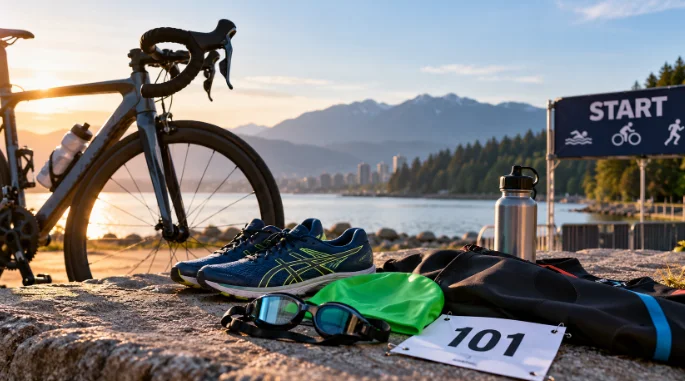
You need far less than the sport’s shop windows suggest. Here is the honest first-triathlon list — borrow or buy basic versions and upgrade later only if you stick with it.

Race week & race day

Fuelling, pacing and the morning itself

Two things undo more first-timers than a lack of fitness: going out too hard, and getting the simple logistics wrong. Both are easy to fix with a plan. On pacing, the rule across all three legs is to begin a notch easier than your ego wants. A triathlon is a continuous effort, and energy spent too early in the swim or on the first climb of the bike is gone for good. Settle, find a rhythm you could hold a short conversation at, and let yourself press only in the final third if you still feel strong.

On fuelling, a sprint race needs little more than a good breakfast two to three hours beforehand, water, and perhaps a gel on the bike. As distances grow, so does the need to eat and drink on the move — which is exactly why you practise it in training rather than experimenting on race day. The golden rule is nothing new on race morning: no untested food, no brand-new shoes, no first-ever wetsuit. Everything you wear, eat and use should already be familiar from training.

Finally, the morning logistics. Arrive early, rack your bike and lay out your transition exactly as you have practised, pump your tyres, and walk the route from the swim exit to your spot and from your spot to the bike and run exits so there are no surprises. Check your bike over, fasten your helmet before you move it, and give yourself time for a short warm-up and a few easy minutes in the water. Calm preparation is what turns a daunting first start line into simply the next thing you have trained to do.

Interactive · race-day math

Finish-time predictor

Enter the paces you hold in training and get a realistic finish estimate with splits, including a little time in each transition. Use steady, repeatable efforts — not your all-out best.

Distance
Latest coaching notes

From the Okanagan Tri blog

Short, practical reads on getting to your first finish line — swims, bricks, transitions and race-week nerves.

All blog posts

Where to race

Racing in Penticton & the Okanagan

The Okanagan Valley of British Columbia is one of Canada’s great endurance-sport playgrounds, and Penticton in particular has a long reputation as a triathlon town. Warm, swimmable lakes, quiet valley roads for cycling, and a summer season of community events make it an ideal place to train for or complete a first triathlon. Many beginners plan their season around a mid-to-late-summer local race, when the water is warmest and the days are long.

If you are travelling to race here, build in a day to settle: drive or ride the bike course if it is open, swim a short distance in the actual lake to get used to the temperature and the sighting lines, and scout the transition area so race morning is calm. Respect the water — mountain-fed lakes can be cooler than they look — and check each event’s own rules on wetsuits, cut-off times and course maps.

This website is an independent beginner triathlon resource. We are not an event, a series or a club, and we are not affiliated with any race organizer. We point you toward the region because it is a wonderful place to swim, bike and run — and because learning on roads and water like these makes the whole sport click.

Mountain lake in the valley at golden hour
Get it right

Beginner mistakes — and a few edges for your second season

If this is your first race

  • Starting the swim too fast and spiking your heart rate in the first 100 m.
  • Skipping brick workouts, then being shocked by heavy legs off the bike.
  • Buying expensive gear before building basic fitness and consistency.
  • Trying new food, kit or a new wetsuit on race day instead of in training.
  • Neglecting transitions — free time thrown away through disorganization.

If you are stepping up

  • Add structure: one quality bike and one quality run session per week.
  • Practise race-pace nutrition on long rides so your gut is trained too.
  • Work swim technique, not just distance — efficiency beats effort.
  • Rehearse open-water starts and pack running to stay calm in crowds.
  • Build the bike: on longer races, time saved on the bike is time banked for the run.
Common questions

Beginner triathlon FAQ

How long should a beginner triathlon training plan be?

For a sprint-distance first race, 8 to 12 weeks is realistic if you already have a small base of swimming, cycling and running. If you are starting closer to zero, give yourself 12 to 16 weeks so the early weeks can build you up to the starting fitness safely. Consistency over those weeks matters far more than any single long session.

What are the triathlon distances?

The common distances are super-sprint (around 400 m swim, 10 km bike, 2.5 km run), sprint (750 m, 20 km, 5 km), Olympic (1.5 km, 40 km, 10 km) and 70.3 or half (1.9 km, 90 km, 21.1 km). Most beginners should start at sprint distance.

How many hours a week do I need to train?

A beginner sprint plan typically runs from about three hours a week early on up to five or six at its peak, spread across roughly six short sessions — about two swims, two rides and two runs, plus a rest day. Longer distances need more time, which is why they come in later seasons.

What is a brick workout?

A brick is two disciplines back to back in one session, most often a bike immediately followed by a run. It trains your legs for the strange, heavy feeling of running after cycling and rehearses the T2 transition, so race day feels familiar rather than alarming.

What are T1 and T2 in a triathlon?

They are the transitions. T1 is the changeover from the swim to the bike, and T2 is from the bike to the run. Your helmet must be on before you move the bike and off only after you rack it. A tidy, consistent transition setup saves beginners real time.

Do I need a wetsuit and a fancy bike?

No. A wetsuit helps in cold open water and where rules allow, but many first races are warm enough without one. For the bike, any roadworthy road or hybrid bike with a safety check will get you to the finish. Build fitness first; upgrade gear later only if the sport sticks.

How do I predict my finish time?

Add up your swim, bike and run times at steady training paces, then add a few minutes for the two transitions. Our finish-time predictor does this for you — enter your swim pace per 100 m, your bike speed, and your run pace per kilometre for the distance you choose.

Where can I do a beginner triathlon in British Columbia?

The Okanagan, including Penticton, is a popular region with warm lakes and good cycling and running terrain, and it hosts community events through the summer. Choose a sprint or super-sprint for your first race, and always check the specific event’s rules, course maps and cut-off times.

Your first finish line is closer than you think

Build your weekly plan, estimate your finish, and start swimming, cycling and running toward race day.

Build my plan Read the blog