Do Strava Challenges Help You Train for a Triathlon?

· 13 min read
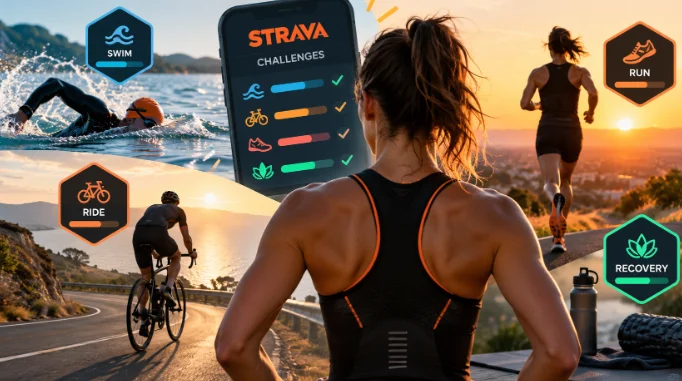
A Strava badge can make an ordinary Tuesday run feel like an achievement. A leaderboard might persuade you to get on the bike when you’d rather stay home. But preparing for a triathlon involves more than collecting kilometres, and a challenge that rewards extra activity doesn’t always reward the training you actually need.
Strava challenges can help beginner triathletes stay consistent, particularly during an eight- or twelve-week training block. The trick is choosing goals that support swimming, cycling, running and recovery rather than allowing an app to decide what your next workout should be.
What Does a Strava Challenge Actually Measure?#
A Strava challenge measures progress toward a defined activity goal. Depending on the challenge, that might involve distance, elevation gain, moving time, activity frequency or contributions to a group target.
These metrics are useful because they’re straightforward to track. They’re also incomplete measures of athletic development. Completing a cycling distance challenge doesn’t demonstrate that your swimming has improved, your running feels easier or you’re adequately recovered.
Distance goals, activity targets and completion badges#
Strava offers challenges lasting from a single day to a month or longer. Participants may earn digital badges when they satisfy the challenge conditions, with progress displayed through the app.
A completion badge confirms that the recorded activities met the specified criteria. It doesn’t independently establish whether those activities were appropriate for your training programme.
Consider a beginner preparing for a Sprint triathlon. Their weekly schedule includes two swims, two rides, two runs and a rest day. A monthly cycling challenge could provide extra motivation to complete planned rides without interfering with the other disciplines.
But if the cyclist starts adding unnecessary kilometres to reach a higher target, the same challenge could disrupt the programme.
The distinction is simple: recording more activity isn’t automatically the same as preparing better for a race.
Leaderboards and group challenges#
Leaderboards introduce comparison. Instead of simply completing a personal goal, you can see how your eligible activities rank against other participants.
Strava challenge leaderboards may rank athletes by distance, time, elevation or pace, depending on the event. Some challenges also involve collective goals, where participants contribute toward a shared total.
For competitive athletes, these features can create useful motivation. For others, constantly comparing results with stronger or more experienced participants may become discouraging.
A September 2026 study published in Digital Health, examining adults in the United States, Germany and Austria, found substantial differences in how people perceived physical activity leaderboards. Some participants valued competition and social connection, while others preferred personal progress over comparisons with strangers.
The findings don’t establish that leaderboards improve triathlon performance, and the study wasn’t specific to Canadian triathletes. They do support a practical observation: a motivational feature isn’t equally helpful for everyone.
When Digital Challenges Help Beginner Triathletes#
The strongest use of a fitness challenge is to reinforce a habit that’s already part of a sensible training plan.
Triathlon preparation requires several different activities every week. A beginner might enjoy cycling enough to ride regularly but struggle to schedule swimming. Another athlete might be comfortable with all three sports yet lose motivation during a long training block.
Digital goals can help with these specific problems when the target is chosen carefully.
Making consistency visible#
Training progress isn’t always obvious from individual sessions. You might swim the same distance at approximately the same pace for several weeks before noticing that breathing feels easier or technique requires less effort.
A training log makes the accumulated work visible. Completing the planned sessions becomes a measurable achievement even when there isn’t an immediate personal best.
For example, an athlete preparing for their first Okanagan Sprint could review the previous four weeks and see that they’ve completed most of their scheduled swims and rides. That information may be more meaningful than a single unusually fast workout.
Garmin Connect and other training platforms can provide similar historical views. The useful feature isn’t necessarily the badge itself; it’s the ability to recognize a pattern of sustainable preparation.
Finding accountability without racing every workout#
Group challenges can make training feel less solitary. Friends preparing for different events might share their completed sessions, exchange encouragement or agree on a collective activity goal.
That kind of accountability works especially well when the group values participation rather than ranking.
A beginner who completes an easy recovery ride shouldn’t feel that the session matters less because another participant cycled twice as far.
For an introductory triathlon, consistency, technique and manageable progression are usually more useful priorities than accumulating the largest possible weekly total.
When Challenges Start Working Against Your Plan#
Digital motivation becomes less helpful when a challenge begins influencing decisions that should be based on your training needs, fatigue or health.
A target can be reasonable when you join and inappropriate several weeks later. Work commitments, illness, disrupted sleep or a change in fitness can all affect how much training is sensible.
The problem with protecting a daily streak#
Imagine your training plan schedules Monday as a full rest day after a longer weekend ride and run. Your fitness app, however, shows that you’ve recorded activity every day for nearly a month.
Completing another workout would preserve the streak. Resting would break it.
From a training perspective, the answer should depend on recovery needs, not the number displayed on your phone.
Rest is part of endurance preparation. Hard training provides a stimulus, while recovery allows the body to adapt. Repeatedly adding sessions without sufficient recovery can contribute to persistent fatigue and declining performance.
A short walk may be appropriate on some recovery days, but it shouldn’t become an obligation imposed by an app. A scheduled full rest day is a legitimate part of the programme, even when it produces no activity record.
When a leaderboard encourages the wrong workout#
Suppose you’re an experienced recreational runner preparing for your first Sprint triathlon. Running is already your strongest discipline, while swimming requires the most attention.
A monthly running leaderboard offers an appealing target. You start adding kilometres to improve your position, then find yourself arriving at swim sessions tired and skipping technique work.
Your running statistics look better. Your overall triathlon preparation may not be improving.
This is a problem of misplaced incentives rather than a flaw unique to Strava. Any measurement system can distort priorities when one easily recorded number receives more attention than the wider objective.
If a challenge causes you to neglect weaker disciplines, rush recovery or train through pain, it’s no longer serving its intended purpose.
What the App Is Rewarding Matters More Than the Badge#
Fitness apps use elements commonly associated with games: progress bars, achievement badges, rankings, milestones and notifications. This approach is generally called gamification, meaning the use of game-like features in activities that aren’t themselves games.
In sport, these features can make long-term progress easier to recognize. Completing a monthly activity target produces a visible record of participation. A leaderboard, meanwhile, ranks performance relative to other athletes. Neither mechanism guarantees meaningful fitness improvement, but both can provide feedback about specific behaviour.
Digital platforms often borrow the same visual language — progress bars, rankings and congratulatory badges — even when the underlying incentives are quite different. Completing a training challenge produces a measurable achievement, while a prize draw introduces chance, and some paid digital games put money at risk.
An ethereum casino is an example of the latter category of digital entertainment, where the incentive structure differs fundamentally from completing a workout or improving a race time.
The distinction matters because a rewarding interface doesn’t necessarily measure meaningful progress. For a beginner triathlete, the most useful digital feedback is the kind that reinforces sustainable training habits, including recovery days that produce no badge at all.
Even within fitness applications, rewards deserve different interpretations. A completion badge recognizes that a specified condition was met. A performance ranking compares recorded results. A prize-based promotion may add eligibility requirements or an element of chance unrelated to physical improvement.
These mechanisms aren’t interchangeable, and they shouldn’t be treated as equally valuable simply because they share similar visual design.
A useful question to ask about any challenge is: What behaviour would I change to earn this reward, and would that change actually improve my race preparation?
If the answer involves consistently completing appropriate workouts, the challenge may be worthwhile. If it involves adding unnecessary distance, ignoring fatigue or chasing a result unrelated to your goal, reconsider participating.
How to Choose a Challenge That Fits Swim-Bike-Run Training#
Start with the race, then choose the digital target. Reversing that order makes it easy to build your training around whichever challenge happens to appear in the app.
A monthly distance challenge makes more sense when it supports an actual race goal, so building a first-race plan around a real event should come before choosing what to track or compete for online.
Use this comparison to identify which types of digital challenges are most likely to support your preparation.
| Challenge type | Potential benefit | Main drawback | Best use for beginners |
|---|---|---|---|
| Activity streak | Encourages regular participation | May conflict with rest days | Short-term habit building without pressure to train daily |
| Distance challenge | Supports consistent endurance work | Can encourage unnecessary mileage | Goals that fit planned rides or runs |
| Leaderboard | Adds competition and social comparison | May encourage excessive effort | Athletes who enjoy competition without changing their programme |
| Group goal | Creates accountability and social support | Individual contributions may be uneven | Friends or training partners working toward a shared goal |
| Personal milestone | Highlights individual improvement | May overlook technique or recovery | Tracking meaningful progress against your own baseline |
Match the challenge to your weakest training habit#
Consider three beginners following an eight- or twelve-week plan.
The confident cyclist: Cycling sessions are rarely missed, but swimming gets postponed. Another bike-distance badge offers little additional value. A personal goal of completing scheduled swims is more useful, even if it has to be tracked manually rather than through an available Strava challenge.
The enthusiastic runner: Running feels natural, but cycling endurance is limited. A cycling target aligned with planned rides may help establish consistency. A competitive running leaderboard could distract from the actual preparation needed.
The balanced beginner: All three disciplines are progressing, but motivation fades during repetitive weeks. A small group challenge with supportive friends may help maintain engagement without requiring extra sessions.
The best target depends on the behaviour you’re trying to strengthen, not which challenge has the most attractive badge.
Protect rest days and easy sessions#
Before joining, compare the challenge requirements with your existing schedule.
If completing the target requires additional hard workouts, a longer ride than you’re prepared for or activity on planned rest days, choose a different challenge.
You can also leave challenges unfinished. Missing a digital goal doesn’t erase the fitness developed through your scheduled training.
When injury, illness or unusual fatigue interrupts your programme, recovery takes priority over an app’s completion deadline.
Check activity visibility and prize eligibility#
Strava distinguishes between personal challenge progress and public leaderboard participation. According to its Help Center, eligible activities with privacy settings limited to followers or yourself may contribute toward personal challenge goals, while public challenge leaderboards generally require activities visible to everyone. Manually entered activities may also count toward personal progress without qualifying for leaderboard results.
Before joining a public challenge, review your activity visibility and map settings. Strava allows users to hide portions of their routes or entire maps, but hiding a route section doesn’t make every detail of a public activity private.
For athletes regularly training near home, that distinction matters more than appearing on a leaderboard.
Some sponsored challenges include prizes or other rewards. Strava notes that prize eligibility can depend on geographic restrictions, even when users are allowed to participate in the challenge itself. Canadian participants should check the specific promotion’s terms rather than assuming that completing a challenge guarantees eligibility.
If a challenge requires more public information than you’re comfortable sharing, tracking the same goal privately is a reasonable alternative.
A Four-Week Test: Is the App Helping You?#
You don’t need an elaborate experiment to decide whether digital challenges are useful. Try one carefully chosen goal for four weeks and assess whether it improves adherence to your existing training plan.
The following is a practical self-assessment, not a scientifically validated fitness test.
- Week 1 — Establish your baseline. Record the sessions you intend to complete, including rest days. Choose one challenge that fits the programme without adding extra workouts.
- Week 2 — Watch your decisions. Notice whether the app helps you begin planned sessions or pressures you to change their duration or intensity.
- Week 3 — Review the balance. Check whether swimming, cycling and running are receiving appropriate attention. Consider sleep, fatigue and motivation alongside your recorded activity.
- Week 4 — Evaluate the result. Compare your completed sessions with the original plan. Decide whether the challenge improved consistency or simply increased the amount of activity recorded.
At the end, ask yourself four questions:
- Did I complete more of my planned workouts without adding unnecessary sessions?
- Did I maintain appropriate recovery and respond to fatigue?
- Did all three disciplines receive the attention they needed?
- Did the challenge make training more enjoyable, or did it create pressure?
If the challenge improved consistency while preserving your training balance, it may be worth continuing. If it mainly encouraged extra mileage or constant comparison, a simpler tracking method could work better.
The Best Motivation Is the One You Can Sustain#
Strava challenges can be genuinely useful for beginner triathletes, particularly those who enjoy measurable goals, friendly competition or seeing their progress accumulate over several weeks.
They aren’t essential. A calendar, training journal or basic activity log can provide many of the same practical benefits without rankings, notifications or public comparisons.
For someone preparing for their first Sprint in Penticton or Kelowna, the real objective is arriving at the start line with enough swimming confidence, cycling endurance, running fitness and recovery to complete the event safely.
If a digital challenge helps you work toward that goal, keep it. If it starts dictating your workouts, changing your priorities or making rest feel like failure, let the badge go.
Your training plan should determine what counts as progress. The app should simply help you see it.