How to Prepare for an Open-Water Triathlon Swim in the Okanagan

· 13 min read
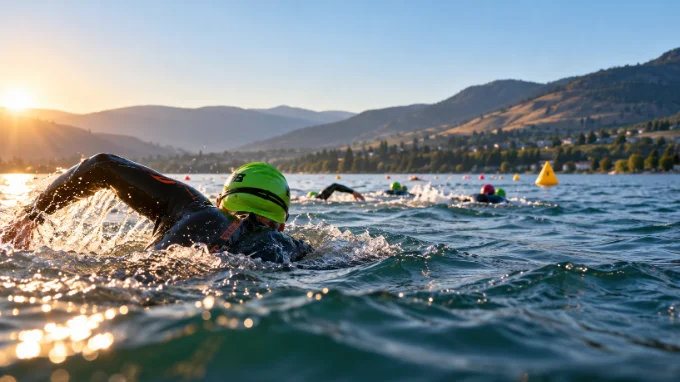
Swimming 750 metres in a pool and swimming the same distance in Okanagan Lake are two different experiences. The water moves, the bottom disappears from view, and there’s no wall waiting at the end of each length. If your first triathlon includes an open-water swim, the goal isn’t simply to build enough endurance to cover the distance. It’s to become comfortable, competent and prepared for the conditions you’ll encounter on race morning.
Are You Ready to Move From the Pool to the Lake?#
You’re ready to begin supervised open-water training when you can swim comfortably in a pool, control your breathing, maintain your position in the water and recover calmly when something interrupts your rhythm. Swimming the full race distance is useful, but distance alone doesn’t establish open-water readiness.
Swimming Canada identifies waves, currents, cold water and the absence of pool walls as important differences between controlled swimming environments and open water. Its safety guidance emphasizes assessing risks before entering natural bodies of water.
Pool skills that should feel comfortable first#
Before your first lake session, make sure you can:
- Swim continuously at a relaxed pace without becoming breathless.
- Float or tread water comfortably without depending on a wall.
- Roll onto your back to rest and recover your breathing.
- Stop, change direction and resume swimming without rushing.
- Clear water from your goggles and regain your rhythm.
- Recognize when you’re becoming fatigued and need assistance.
These abilities matter because an open-water swim rarely unfolds exactly as planned. A wave might interrupt your breathing, another swimmer might cross your path, or your goggles could leak.
A confident swimmer can respond without immediately increasing effort. Someone who relies on reaching the next pool wall may find the same interruption much harder to manage.
If any of these basic skills remain difficult, work with a qualified swimming instructor before progressing to the lake.
Why swimming farther isn’t the same as swimming safely#
Consider two beginners preparing for a 750 m sprint-triathlon swim.
One can complete 1,000 m in a pool but becomes anxious when visibility is poor. The other swims shorter distances yet can float calmly, change strokes and control breathing when interrupted.
Neither is automatically ready for an unsupported open-water swim. The first needs environmental confidence; the second needs additional endurance.
The best preparation develops both.
| Pool swimming | Open-water swimming |
|---|---|
| Clear lane markings guide direction | Landmarks and buoys help with navigation |
| Walls provide regular stopping points | Rest may require floating or supported assistance |
| Temperature is generally controlled | Conditions vary by location, depth and season |
| Other swimmers follow assigned lanes | Swimmers may approach from several directions |
| Lifeguard coverage is common during public sessions | Supervision and rescue support vary considerably |
| Distance is easy to measure | GPS estimates and swim routes may be less precise |
A pool remains the best place to develop stroke efficiency and endurance. Lake training adds environmental skills that a pool cannot fully reproduce.
Understanding Okanagan Lake Conditions#
Okanagan Lake provides excellent opportunities for open-water swimming, particularly during the warmer months, but conditions shouldn’t be judged by the weather on shore.
A sunny afternoon in Kelowna doesn’t guarantee warm water, calm waves or suitable swimming conditions. The same lake can feel quite different depending on location, wind direction and time of year.
Water temperature and cold-water exposure#
Spring runoff and seasonal warming influence the lake’s temperature. Areas that seem comfortable in late summer may be considerably colder earlier in the season.
The Gyro Swim Loop in Kelowna identifies late May through September as its generally more comfortable swimming period and notes that water temperatures can fall below 15°C outside that window.
According to Health Canada, sudden immersion in water at 15°C or below can cause cold shock, including involuntary gasping, breathing difficulties and impaired swimming ability. Hypothermia is another concern with prolonged exposure.
Cold-water adaptation shouldn’t mean forcing yourself to tolerate increasingly uncomfortable conditions.
For your first sessions, use conditions approved by a qualified instructor, follow their guidance for entering the water and keep the activity within your demonstrated capabilities. If your breathing becomes uncontrolled or you feel unwell, leave the water with assistance.
A wetsuit can provide insulation and buoyancy, but neither benefit makes a cold or poorly supervised swim automatically safe.
Wind, waves, boats and visibility#
Wind can turn an otherwise manageable lake swim into a challenging session. Small waves may disrupt your breathing rhythm, while larger chop makes navigation and visibility more difficult.
Boat traffic creates another consideration. A swimmer’s head is difficult to spot from a moving watercraft, particularly when waves are present.
Choose a designated swimming area or an appropriately supervised training session rather than heading into an unfamiliar section of the lake.
Kelowna’s Boyce-Gyro Beach has an established open-water training area known as the Gyro Swim Loop. The marked route measures approximately 800 m, with buoys spaced 50 m apart. Swimmers are directed to follow the loop clockwise and stay on the designated side of the markers.
The loop is useful for practising navigation, but it is not lifeguarded. Its published guidance explicitly warns swimmers not to swim alone.
For a newcomer, a marked route should be treated as a navigation aid, not a replacement for professional supervision or an emergency plan.
When to cancel or move the session indoors#
A lake session isn’t worth completing simply because it’s written into your training schedule.
Postpone, cancel or move indoors when:
- Thunderstorms or lightning threaten the area.
- Wind, waves or visibility exceed your abilities or the safety team’s limits.
- The water is too cold for your preparation, equipment or the available support.
- Boat traffic or floating debris creates an unacceptable hazard.
- The beach has a swimming advisory or closure.
- Your qualified supervisor or appropriate rescue support is unavailable.
- You’re unwell, unusually fatigued or struggling to control your breathing.
Water quality deserves attention. Interior Health publishes swimming advisories and beach closures, while local beach operators monitor conditions. Sampling results don’t represent real-time water quality, so posted warnings and current local notices still matter.
Wildfire smoke can also affect summer training in the Okanagan. Health Canada recommends checking the Air Quality Health Index and modifying or rescheduling strenuous outdoor activity when smoke conditions warrant it.
If the lake isn’t suitable, a pool session focused on breathing, technique or steady endurance is a productive alternative. The training objective matters more than the location.
A Four-Session Progression for Your First Lake Swims#
Your first four open-water sessions should develop skills rather than chase distance. The following progression is a framework to discuss with a qualified coach, not a fixed programme to attempt independently.
Each session assumes suitable conditions, appropriate safety supervision and an established emergency response plan. Move forward only when the previous skills feel controlled and repeatable. Some swimmers will need several sessions at one stage.
Session 1 — Water comfort and breathing#
The first session is about becoming familiar with the environment.
Begin in an area appropriate to your ability, under direct supervision. Notice how the water temperature, light and visibility differ from the pool.
Practise controlled breathing, comfortable floating and returning to a resting position. If your coach considers it appropriate, swim a few short, easy lengths parallel to shore.
The goal isn’t to reach a particular marker. It’s to discover whether you can maintain the same calm breathing rhythm you use indoors.
If you become breathless or uneasy, stop with your coach’s assistance rather than trying to push through the sensation.
Move forward when: You can enter the water comfortably, swim short controlled sections and recover your breathing without distress.
Session 2 — Sighting and staying on course#
In a pool, the black line on the bottom tells you where to go. In a lake, you need to look ahead occasionally.
This technique is called sighting.
Choose a fixed landmark or designated buoy with your coach. During a comfortable freestyle stroke, briefly lift your eyes enough to locate it, then return your head to its normal position.
Avoid lifting your entire upper body out of the water. That creates unnecessary resistance and can interrupt your breathing.
Try sighting every few strokes at first, adjusting according to visibility and how straight you’re travelling.
Sighting should become a small addition to your normal swimming rhythm, not a separate movement that leaves you exhausted.
Move forward when: You can follow a short, supervised course without repeatedly losing direction or disrupting your breathing.
Session 3 — Swimming with other people nearby#
Triathlon swims add an unfamiliar social element: other swimmers may be directly beside or ahead of you.
In a controlled group session, practise maintaining your own pace while other swimmers move nearby.
The objective isn’t to imitate a crowded race start. It is to become familiar with movement and occasional splashing without feeling compelled to accelerate.
Work on keeping a comfortable distance, adjusting your line when needed and recovering calmly after a minor interruption.
A coach may introduce basic drafting concepts, but beginners should prioritize spatial awareness and control over potential speed gains.
Move forward when: You can remain composed around other swimmers and change course without losing control of your stroke.
Session 4 — A controlled race-style rehearsal#
The final session combines the skills you’ve developed.
With your coach and safety team, practise a short, marked swim that includes a controlled entry, settling into your normal stroke, sighting, navigating a turn and exiting the water.
There is no need to simulate an aggressive mass start.
If conditions and your demonstrated abilities permit, gradually extend the distance toward the requirements of your chosen event. Otherwise, continue building endurance in the pool and repeat shorter supervised lake sessions.
Pay attention to how you feel after exiting. Moving from a horizontal swimming position to standing and walking may feel different after sustained effort.
Move forward when: You can complete the approved rehearsal calmly and your coach agrees that you’re ready for the next stage of race preparation.
For swimmers in Kelowna, Across the Lake Swim has organized qualified-coach open-water clinics at Boyce-Gyro Beach. These sessions have included sighting, swimming near others and adapting to lake conditions. Similar opportunities may be available in future seasons, but schedules and participation requirements should be confirmed with the organizers.
Wetsuits, Goggles and Other Useful Gear#
You don’t need a collection of expensive accessories for your first open-water swim. Equipment should solve a real problem: maintaining appropriate warmth, improving visibility or helping you swim comfortably.
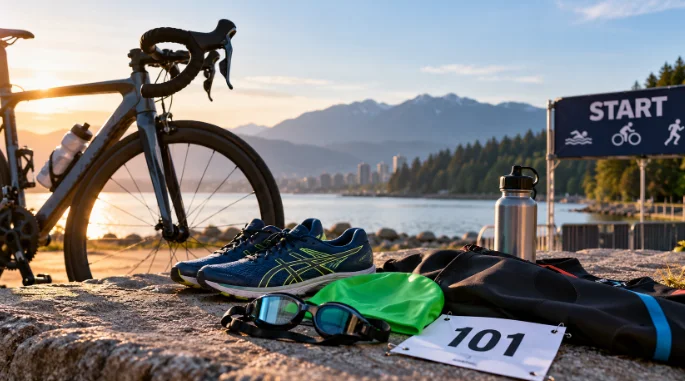
A well-fitting pair of goggles is essential. Choose lenses that work in the expected light conditions and practise wearing them in the pool. Bring a spare pair to race day.
A brightly coloured swim cap can make you more visible to other water users. Some events provide their own mandatory caps, so check the athlete instructions.
A triathlon wetsuit may be useful for warmth and buoyancy, particularly in cooler water. Fit matters: a suit that restricts breathing or shoulder movement can create problems rather than solve them. Practise swimming in it under supervision before race day.
Wetsuit rules depend on the event, athlete category and officially measured water temperature. Triathlon BC adopts World Triathlon competition rules with applicable provincial amendments, so verify the current requirements instead of assuming a wetsuit is always permitted or mandatory.
An inflatable swim safety buoy improves visibility during suitable training sessions, but it isn’t a certified personal flotation device or a substitute for supervision. Some races prohibit personal tow floats or other additional equipment. Check the race rules before using one in competition.
For training, prioritize comfortable goggles, appropriate thermal protection, a visible cap and a qualified safety arrangement. Waterproof watches and advanced tracking equipment can wait.
How to Handle the First Minutes of a Triathlon Swim#
The opening minutes of a triathlon swim should feel controlled, not frantic.
First, understand the event’s start procedure. Some races release swimmers in groups, while others use rolling or individually spaced starts.
If your event allows self-seeding, position yourself according to your realistic swimming ability. Beginners who prefer more space may feel more comfortable toward the back or outside of a group, provided they remain within the designated starting area.
When the start begins, resist the temptation to match the pace of swimmers passing you.
Instead:
- Enter according to the event instructions and establish a controlled breathing rhythm.
- Begin at an effort you can maintain comfortably rather than sprinting toward the first buoy.
- Sight regularly enough to remain on course without constantly lifting your head.
- Keep an appropriate distance from other swimmers, particularly around turns.
- Follow the event’s procedures for requesting assistance if you become distressed.
If your breathing becomes uncontrolled, you feel dizzy or you’re unable to continue safely, stop and signal the safety team immediately. Do not attempt to finish the swim through serious distress.
Race-day safety personnel, support craft and withdrawal procedures should be explained in the athlete briefing. Know those arrangements before entering the water.
The swim exit also deserves a little practice. You may feel temporarily unsteady when standing after a sustained swim. Take the transition at a controlled pace and use assistance if necessary.
A few seconds gained by rushing out of the lake aren’t worth losing your balance or becoming disoriented.
Your Final Open-Water Safety Check#
Before every training swim, make the decision to enter the water based on current conditions, not the distance you planned to cover.
Use this checklist:
- Check the weather, wind and potential for thunderstorms.
- Confirm current water conditions and suitable equipment.
- Review local swimming advisories and beach closures.
- Choose an appropriate area with qualified supervision and a clear rescue plan.
- Identify the route, entry point and safe exit options.
- Check for boat traffic, floating debris and other hazards.
- Make sure your goggles, cap and wetsuit, if used, fit properly.
- Know how to signal for assistance and when to stop.
- Assess whether you’re physically well and sufficiently rested for the planned session.
Before race day, add the organizer’s athlete briefing, published swim course, current wetsuit rules and official water-safety instructions to that check.
If you’re preparing in Penticton rather than Kelowna, don’t assume conditions will match a previous training session elsewhere on Okanagan Lake. Familiarize yourself with the actual event venue under appropriate supervision whenever possible.
Getting comfortable in the lake is only one part of preparing for your first triathlon in the Okanagan, where the bike course, race schedule and transition logistics also deserve attention.
The best sign of progress isn’t swimming farther into the lake or recording a faster split. It’s being able to assess the conditions, maintain control of your breathing, follow your intended route and recognize when to ask for help.
Build those skills patiently, with appropriate instruction and safety support, and the open-water portion of your first triathlon becomes a challenge you can approach with preparation rather than uncertainty.