How Much Does Your First Triathlon Cost in BC?

· 13 min read
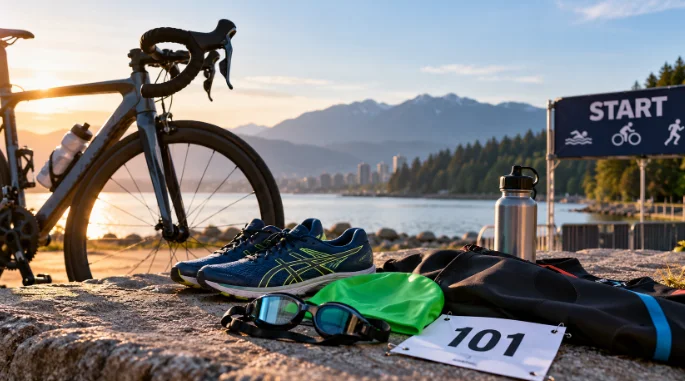
Your first triathlon doesn’t have to involve a carbon-fibre bike, a custom racing suit or thousands of dollars in equipment. If you already own a reliable bicycle and comfortable running shoes, you may be much closer to an affordable start line than the sport’s advertising suggests. The real cost depends on what you own, which race you enter and whether you’re travelling to get there.
For a beginner in British Columbia, the most useful budget isn’t a shopping list of everything triathletes might eventually own. It’s the total amount you’ll need to train safely, register, travel and finish your first event.
The Real Cost of a First Triathlon#
There isn’t one reliable price for a first triathlon. Someone entering a local Try-a-Tri with existing equipment faces a very different bill from someone buying their first bicycle and travelling to Penticton for a weekend.
For a concrete example, the 2027 Peach Classic Triathlon registration page on Race Roster lists early Try-a-Tri entry at C$63.64 and early Sprint entry at C$148.49. Those are event-specific published prices, not averages for British Columbia. Your equipment, training and travel costs come on top.
Three realistic starting situations show where the money goes.
Budget 1 — You Already Own a Bike#
This is the least expensive route into triathlon. You have a bicycle that fits properly, an approved helmet, running shoes and basic swimming equipment. Your existing clothing is comfortable enough for all three disciplines, and you’re entering a nearby event.
Your largest new expense may simply be registration. At the Peach Classic’s published early 2027 rates, that means C$63.64 for Try-a-Tri or C$148.49 for Sprint, before any participant-specific extras not already included in the displayed amount.
You might also need replacement goggles, a bicycle tune-up or additional swimming practice. None of those costs should be assumed to be zero without checking the equipment you actually have.
For someone who already swims, cycles and runs recreationally, the first race can be an extension of existing hobbies rather than an entirely new equipment investment.
Budget 2 — You Borrow or Rent Selected Gear#
Suppose you own running shoes and a suitable bicycle but need a wetsuit for your Okanagan Lake race. Buying one immediately may not make sense if you’re uncertain about continuing with triathlon.
Rental can solve that problem. As a published Canadian example, Element Tri & Bicycle Works listed triathlon wetsuit rentals at C$75 per week in 2026. Combined with the Peach Classic’s early 2027 Sprint entry of C$148.49, that produces C$223.49 in identified entry and wetsuit-rental costs, before travel, training and any other equipment.
That isn’t a complete race budget, but it illustrates how renting one specialised item can prevent a larger upfront purchase.
Borrowing a bicycle may also be practical if the owner agrees and the bike fits properly. Have it inspected, confirm the race permits that bicycle type and practise riding it well before the event.
A borrowed bike that doesn’t fit or has unreliable brakes isn’t a bargain.
Budget 3 — You’re Starting Without Equipment#
Starting from scratch changes the calculation considerably. The bicycle is likely to be your largest purchase, followed by a suitable helmet, running shoes, swimming equipment and any clothing you don’t already own.
GoTri.ca’s introductory guidance provides an illustrative equipment budget that includes a C$500–C$1,000 bicycle, C$100 helmet and C$100 running shoes. These are general planning figures rather than verified 2027 retail prices, so current local quotes should replace them before you make a purchase.
Buying a new road bike isn’t automatically necessary. A suitable used road or hybrid bicycle may work for a beginner-friendly, non-drafting event, subject to the organizer’s rules and a mechanical inspection.
The other option is to delay buying altogether. Renting or borrowing allows you to discover whether you enjoy training for three sports before committing to equipment you’ll need to maintain and store.
For an entirely new athlete, remember that the cost of learning to swim safely, accessing a pool and building cycling confidence can matter as much as the race-day shopping bill.
What You Actually Need to Buy#
Triathlon combines three sports, but that doesn’t mean you need three complete sets of specialist equipment. The best first-race purchases are items you can use repeatedly during training, not accessories that save a few seconds in transition.
Swim equipment#
Comfortable goggles and suitable swimwear are the essentials. A swim cap may be supplied by the organizer, and a basic training swimsuit is perfectly adequate for pool sessions.
For open-water racing, a wetsuit may provide thermal protection and buoyancy. Its usefulness depends on water conditions, your comfort and the event’s equipment rules. A properly fitted suit should be tested during supervised practice rather than worn for the first time on race morning.
Check the current race regulations before budgeting for a wetsuit. Some conditions permit optional use, while others impose restrictions or specific requirements. Renting is sensible when you need one for a limited number of sessions, provided the rental period allows time to practise.
Bike equipment#
Your bicycle doesn’t need to look like a professional time-trial machine. It needs to fit, handle predictably and be mechanically safe.
For most beginner-friendly non-drafting events, a conventional road bike is sufficient. Some events also accept hybrid bicycles, but equipment rules vary. Mountain bikes may be allowed at certain community races, although their tyres and riding position can make road cycling slower and more demanding.
Budget for maintenance before upgrades. Worn tyres, unreliable brakes, damaged components or poorly adjusted gears are reasons to visit a bike shop, not problems to ignore until after the race.
A properly fitted, approved helmet is essential. British Columbia requires cyclists to wear an approved bicycle helmet on public roads, subject to limited legal exemptions. Race organizers also enforce their own helmet rules.
Don’t buy a used helmet with an unknown impact history. A new, correctly certified helmet that fits securely is a better use of money than an aerodynamic accessory.
You can usually postpone clip-on aero bars, carbon wheels, cycling power meters and dedicated triathlon cycling shoes. Ordinary flat pedals and comfortable athletic shoes can be perfectly reasonable for a first event if they’re compatible with your bike and permitted by the organizer.
Run and transition equipment#
Your regular running shoes are usually enough, provided they’re comfortable, in good condition and familiar from training.
A tri suit is convenient because you can wear it through the swim, bike and run. It isn’t necessarily required. Many beginners use snug, quick-drying athletic clothing suitable for their event’s rules.
A race-number belt, elastic laces and a small transition towel can make the changeovers simpler. They are inexpensive conveniences rather than essential performance investments.
For a first Sprint, having familiar clothing and an organized transition routine will generally be more valuable than buying an elaborate collection of accessories.
Race Entry Fees and Other Registration Costs#
Entry fees vary by distance, organizer and registration date. The most useful comparison is the amount shown at the final checkout stage, not the lowest advertised base price.
The Peach Classic in Penticton provides a clear example of tiered pricing. Its 2027 Race Roster listing, available in October 2026, shows the following published amounts in Canadian dollars.
| Registration period | Try-a-Tri | Sprint |
|---|---|---|
| August 31, 2026 – January 1, 2027 | C$63.64 | C$148.49 |
| January 1 – April 1, 2027 | C$79.55 | C$159.09 |
| April 1 – June 6, 2027 | C$84.85 | C$175.01 |
| June 6 – July 4, 2027 | C$95.46 | C$190.92 |
Source: 2027 Peach Classic Triathlon registration listing on Race Roster. The platform states that displayed prices include mandatory charges and fees where applicable. Prices and event details are subject to change; verify the final checkout total.
These figures reveal two useful differences. First, the shorter event has a substantially lower entry cost. Second, waiting until the final registration period increases the listed Sprint price by C$42.43 compared with the earliest tier.
Entry fees aren’t the only registration expense#
Depending on the event and your membership status, registration may involve processing charges, taxes, day-of-race insurance or a provincial sport membership requirement.
Triathlon BC offers annual memberships with insurance benefits for eligible members participating in sanctioned activities. Its published adult membership schedule lists C$80 for a new individual adult member, including the Triathlon Canada affiliation component. Membership terms and rates should be checked for the relevant race year.
For a single event, an applicable one-day participation option may be less expensive than annual membership. If you plan to race repeatedly or join organized club training, compare the benefits and total costs rather than automatically choosing the cheapest checkout option.
Insurance arrangements also have limits. Don’t assume that an event participation fee replaces ordinary medical or travel insurance, particularly if you’re travelling from outside the province or country.
Why registering earlier can make a difference#
Early registration offers a straightforward potential saving, but it introduces a trade-off: you’re paying before you know exactly how training, work or travel plans will develop.
Before registering months in advance, review the refund, deferral and transfer policies. Some events provide limited options when an athlete becomes injured or can’t attend, while others impose strict deadlines.
Saving money on entry makes sense when you’re reasonably confident about the date and distance. If you’re still learning to swim or uncertain about your readiness, the flexibility of registering later may be worth more than the discount.
The Travel Costs Beginners Often Forget#
For athletes living in Penticton or Kelowna, entering a local race may eliminate the largest travel expenses. Someone driving from another part of British Columbia faces a different calculation.
A weekend trip to an Okanagan triathlon can involve fuel, accommodation, meals, parking and transporting a bicycle. Summer weekends may also coincide with other events and peak visitor demand, making early accommodation planning useful.
Build your travel estimate from the actual itinerary:
- Driving: Multiply your round-trip kilometres by your vehicle’s fuel consumption per 100 km, then apply a current fuel price.
- Accommodation: Count the nights needed for package pickup, mandatory bike check-in and race day. Compare the full rate, including applicable taxes and fees.
- Meals: Budget for ordinary meals and familiar race-day food rather than relying entirely on restaurants.
- Bike transportation: Check whether your bicycle fits securely in your vehicle or requires an appropriate rack or transport service.
- Parking and local transportation: Review event instructions and accommodation arrangements before assuming either is free.
For example, a 400 km round trip in a vehicle consuming 8 L/100 km requires approximately 32 litres of fuel. Multiply that figure by the current price per litre to estimate fuel spending. The distance and consumption are illustrative assumptions, not a quote for any particular route.
Also check the event schedule before reserving accommodation. Some races require athletes to collect their packages or check in bicycles the day before competition. Arriving on race morning may not be practical or permitted.
If you’re flexible about which event to enter, a nearby race with a slightly higher entry fee may cost less overall than a cheaper race requiring two nights away.
Where to Save Money — and Where Not To#
The simplest way to control a beginner triathlon budget is to distinguish equipment that affects safety and basic comfort from products designed mainly for speed or convenience.
Buy: Properly fitted running shoes if yours are worn out, suitable goggles and an approved bicycle helmet. Pay for necessary mechanical repairs and professional instruction where your swimming skills require it.
Borrow: A suitable bicycle, pump or other non-personal equipment when you can confirm its condition and compatibility. Borrowed gear should be tested during training, not collected the evening before the race.
Rent: A triathlon wetsuit or appropriate bicycle when the arrangement allows sufficient practice time and makes financial sense. Check deposits, damage policies, size availability and return deadlines.
Skip for now: Carbon wheels, advanced cycling computers, power meters, race-specific shoes, expensive aerodynamic helmets and decorative transition accessories.
One distinction deserves particular attention: saving money should never mean reducing the quality of your safety preparation. A properly maintained used bicycle can be excellent value. A bicycle with questionable brakes is not. Likewise, open-water swimming requires adequate skill and appropriate supervision, regardless of how inexpensive the event is.
Don’t overlook ongoing costs either. Pool access, bicycle maintenance, replacing worn running shoes and occasional coached sessions may influence your budget more than a single race-day purchase.
Build Your Own First-Race Budget#
Before deciding how much you can afford to spend, separate purchases you’ll keep using from expenses associated with a specific event. This prevents a new bicycle from being treated as though it costs the same every time you enter a race.
The following worksheet can be copied into a spreadsheet or used as a simple planning checklist.
| Expense | Cost type | Your budget (CAD) |
|---|---|---|
| Race registration and applicable participation fees | Per race | _____ |
| Bicycle purchase or rental | One-time or rental | _____ |
| Helmet and basic cycling equipment | One-time / replacement | _____ |
| Bike inspection or servicing | As needed | _____ |
| Swimwear, goggles and wetsuit | One-time or rental | _____ |
| Running shoes and race clothing | One-time / replacement | _____ |
| Pool access or swimming instruction | Recurring | _____ |
| Travel, accommodation, parking and meals | Per race | _____ |
| Contingency for necessary expenses | As needed | _____ |
| Total first-race budget | All costs combined | _____ |
If you’re buying a bicycle or other reusable equipment, it may help to calculate two totals: the amount of cash you’ll spend before your first race and the smaller amount a subsequent race might cost using the same gear.
This distinction matters because the first event can include substantial setup expenses, while future races may require little more than registration, consumables, maintenance and travel.
Once your budget is clear, choosing and preparing for your first Okanagan race becomes easier because you can compare events by more than their entry fees.
If the numbers seem high, reconsider the distance, location and purchases before abandoning the idea. A shorter local event, borrowed equipment or another few months of preparation may bring the cost within reach.
Your first triathlon should be an investment in a worthwhile experience, not a reason to replace perfectly usable sporting equipment. Start with what you have, spend where safety and comfort genuinely require it, and leave the expensive upgrades until you’ve discovered whether you want a second finish line.