Try-a-Tri vs Sprint Triathlon: Which Should You Enter First?

· 11 min read
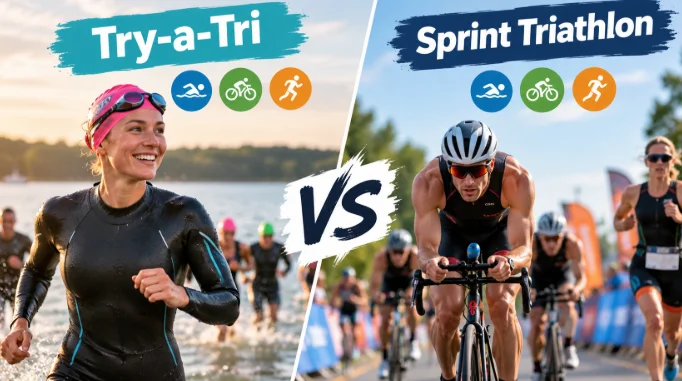
Signing up for your first triathlon usually comes down to one decision: start with a shorter Try-a-Tri or commit to the full sprint distance? Both are accessible to beginners, but the right choice depends on more than how far you can swim, cycle or run. Your comfort in open water, the difficulty of the course and the time you have to prepare can matter just as much as the distances on the registration page.
Try-a-Tri or Sprint: The Short Answer#
Choose a Try-a-Tri if you’re still developing confidence in one or more disciplines. Choose a Sprint if you already have a reasonable fitness base across swimming, cycling and running and can prepare consistently before race day.
You don’t need to complete a Try-a-Tri before entering a Sprint. Many recreational athletes make the sprint distance their first triathlon, particularly if they already swim regularly or have experience with running and cycling events.
Here’s how the two formats typically compare.
| Feature | Try-a-Tri / Super Sprint | Sprint Triathlon |
|---|---|---|
| Swim | Usually 250–500 m | Typically 750 m |
| Bike | Usually 6.5–13 km | Typically 20 km |
| Run | Usually 1.7–3.5 km | Typically 5 km |
| Overall effort | Shorter, but still three continuous disciplines | Longer endurance effort |
| Best suited to | Beginners building confidence | Beginners with an established fitness base |
| Main challenge | Learning the race format and managing transitions | Maintaining a controlled effort across all three sports |
Triathlon Canada identifies Super Sprint as a shorter format often called Try-a-Tri in age-group racing. Actual distances can vary between organizers, so the event’s published course should always take precedence over the category name.
Choose Try-a-Tri if you’re still building confidence#
A Try-a-Tri makes sense if you can comfortably cycle and run but are still developing your swimming skills, or if you’ve never combined the three sports in one continuous effort.
The shorter format reduces the total endurance requirement and gives you an opportunity to practise transitions, pacing and race-day organization without committing to a longer event.
That doesn’t mean it’s effortless. You still need sufficient swimming ability, a roadworthy bike and enough conditioning to finish the run after cycling.
A Try-a-Tri is particularly useful when your goal is to experience the sport before deciding whether you want to train for longer distances.
Choose Sprint if you already have a reliable fitness base#
A Sprint is a reasonable first event if you can swim the race distance confidently, ride for around an hour at a comfortable effort and complete a 5 km run or planned run-walk without excessive difficulty.
You don’t need to be fast. You do need to be prepared for the combined demands of the race, including the effort of cycling immediately after swimming and running on tired legs.
For someone who already enjoys recreational cycling, swims regularly and occasionally enters 5 km running events, a Sprint may be a more satisfying first challenge than a considerably shorter format.
The important distinction is between being capable of completing each distance separately and being ready to complete them consecutively.
Why Race Distance Labels Don’t Tell the Whole Story#
The word Sprint tells you approximately how long the race will be. It doesn’t tell you whether the course is flat, whether the swim takes place in a lake or how crowded the start might feel.
Two events with identical distances can offer very different first-race experiences.
Consider the Peach Classic Triathlon in Penticton. Its published course information has listed a 350 m swim, 10 km bike and 2.5 km run for Try-a-Tri, compared with 750 m, 20 km and 5 km for Sprint.
The organizer has also offered a Super Sprint category with the same distances as Try-a-Tri, illustrating why competitors should examine event descriptions rather than relying on labels alone. Check the current edition’s course details before entering.
The swim can change the difficulty of the entire race#
Swimming is often the deciding factor between Try-a-Tri and Sprint, especially for beginners accustomed to pools.
A 350 m swim across part of a lake can feel more demanding than a longer pool session. There are no lane markings beneath you, no walls to rest against and no guarantee of perfectly calm conditions.
At a mass start, other swimmers may be close enough to disrupt your stroke. Even when a race uses smaller waves or rolling starts, you still need to navigate around people and sight toward course markers.
Water temperature is another consideration. Health Canada warns that sudden immersion in water at 15°C or lower can cause cold shock, including involuntary gasping and difficulty swimming.
A wetsuit may provide thermal protection when appropriate, but it doesn’t replace swimming competence.
For a first open-water race, try to complete supervised open-water training in conditions comparable to the event. Assess the weather, water conditions and available safety support before entering, and never train alone in open water.
If you’re comfortable swimming 750 m in a pool but struggle to maintain calm breathing in open water, the shorter distance isn’t necessarily a complete solution. Building confidence in the actual environment comes first.
Bike-course elevation and run conditions matter too#
A 20 km bicycle leg sounds manageable to someone who regularly rides farther. Add sustained climbing, unfamiliar descents or a hot afternoon, and the effort changes considerably.
The Peach Classic offers a useful local example. Its published Sprint bike course has included approximately 210 m of elevation gain, while the Try-a-Tri has used a shorter multi-lap route. The longer course heads onto Naramata Road; the shorter route keeps participants closer to the waterfront.
The run can bring surprises as well. Even a 2.5 km course may include hills, exposed sections or uneven surfaces. At Peach Classic, published run descriptions have included a steep section on Abbott Street.
This is why comparing distances without looking at the actual route can be misleading.
A flat Sprint with favourable swimming conditions may suit one beginner better than a hilly Try-a-Tri in unfamiliar water.
Which Distance Fits Your Current Training?#
The most useful way to choose is to identify your weakest discipline rather than judging yourself by your strongest.
A recreational cyclist might find the 20 km bike leg straightforward but struggle to swim continuously. A confident swimmer might have no trouble in the lake yet lack the endurance to run after cycling.
Use this decision matrix as a practical starting point, not a medical assessment or official race-entry standard.
| Your current ability | Try-a-Tri | Sprint |
|---|---|---|
| Comfortable with short pool swims but little open-water experience | Consider after supervised open-water preparation | Build more swim confidence first |
| Can swim 750 m continuously and comfortably in race-like conditions | Suitable | Reasonable option |
| Comfortable cycling 10 km, but not yet 20 km | Good starting point | Build cycling endurance |
| Can run or run-walk 2.5 km, but 5 km remains difficult | More manageable | Additional preparation needed |
| Already comfortable in all three disciplines | Suitable, possibly conservative | Strong candidate |
| Limited time to train consistently | Often more realistic | Depends on existing fitness |
These recommendations assume you have no medical restriction affecting participation and that your chosen event’s safety requirements can be met.
You’re comfortable cycling and running but new to swimming#
Imagine a recreational runner who completes regular 5 km outings and cycles on weekends but has only recently started swimming laps.
The run distance isn’t the problem. Neither is the bike.
The challenge is entering open water, controlling breathing and swimming without relying on pool walls.
For this athlete, a Try-a-Tri may be the better first event, provided there’s enough time to build the necessary swimming skills.
A beginner-friendly pool-based event could be another option where available.
Entering the shorter distance doesn’t justify attempting an open-water swim before you’re ready.
You’re already active in all three sports#
Now consider someone who swims twice a week, cycles recreationally and can comfortably run 5 km.
They haven’t completed a triathlon, but the individual distances are familiar.
For this person, Sprint is a logical first choice. The training emphasis should shift toward pacing, practising transitions and learning how the three disciplines feel together.
A short brick session — cycling followed immediately by an easy run — helps reveal how different the first few minutes of running can feel after spending time on the bike.
Completing one controlled race-specific rehearsal before event week can also help identify practical problems, from shoe changes to nutrition.
You have limited training time#
Suppose your schedule allows only three or four training sessions each week.
If you’re starting with a reasonable fitness base, that may be enough to prepare for a shorter event with careful planning. But if you’re learning to swim, rebuilding cycling fitness and starting to run at the same time, progress will require more patience.
Rather than choosing a Sprint because it seems like the standard first triathlon, look at what you can sustain across your available weeks.
A useful training schedule needs room for all three sports, adequate recovery and occasional combined sessions. Consistency matters more than trying to compensate for missed workouts with one exhausting weekend.
If your current abilities are limited and your available training time is short, consider postponing registration rather than forcing an unrealistic build.
What to Check Before Registering#
Once you’ve narrowed the choice to Try-a-Tri or Sprint, examine the actual event details before paying.
A race that looks ideal from its distance chart may involve logistics or requirements that change your decision.
Use this checklist:
- Exact course distances: Confirm the swim, bike and run lengths rather than assuming every event follows standard distances.
- Swim environment: Check whether the swim takes place in a pool, lake or other open-water venue, and whether it uses mass, wave or rolling starts.
- Course difficulty: Review elevation, road surfaces, technical turns and whether the bike route involves multiple laps.
- Cut-off times: Check separate swim and bike limits, as well as the final course closure. Don’t assume a generous overall limit means unlimited time for every leg.
- Equipment rules: Confirm helmet requirements, permitted bicycle types, wetsuit rules and any restrictions specific to your category.
- Race support: Review the location of aid stations, transition arrangements, course marshals and swim-safety coverage.
- Entry requirements: Check minimum age, membership or one-day insurance requirements, and any waiver or identification rules.
- Cancellation policies: Understand what happens if you’re injured, unable to travel or affected by an event cancellation.
For sanctioned events in British Columbia, Triathlon BC provides competition rules based on World Triathlon requirements, with provincial additions and amendments. Organizers may also publish event-specific instructions.
Pay particular attention to the start format. A mass start can feel quite different from entering the water individually, even when the swim distance is identical.
Some events also have separate categories that share the same route but differ in eligibility, competitive classification or equipment rules.
Check the latest athlete guide close to race day. Course maps and schedules can change after registration, and the information from a previous edition may no longer apply.
Finally, think about travel. If your first triathlon requires a long drive, overnight accommodation or transporting a bicycle, those additional demands can make race morning less relaxed. A convenient local event with a manageable course may be a better first experience than a more famous race farther away.
Making the Final Decision#
If both distances look achievable, you don’t need to choose the shortest one automatically. Choose the event that offers a realistic challenge without relying on preparation you haven’t yet completed.
A simple decision framework helps:
- Choose Try-a-Tri when your endurance is still developing, you want to become familiar with race logistics or you’d prefer a shorter first experience.
- Choose Sprint when all three disciplines are already manageable and you have enough time to practise them together.
- Delay registration if you cannot yet complete the swim safely, have unresolved health concerns or cannot prepare adequately before the event.
There’s also no requirement to move up immediately after your first race. Some athletes enjoy shorter events because they fit their schedules, while others use them as an introduction before progressing to Sprint or Standard distance.
Once you’ve chosen a distance, planning your first Okanagan triathlon means checking the course, building a realistic training schedule and understanding what race day will involve.
For a first-time athlete, a successful race isn’t defined by choosing the longest available distance or finishing ahead of someone else. It’s completing a challenge you’ve prepared for, managing the conditions and reaching the finish with enough confidence to consider doing it again.
A well-chosen Try-a-Tri can deliver that experience. So can a Sprint. The right one is the race you’re prepared to complete, not simply the one that looks more impressive on the registration form.